We are OG's. We have been ColdFusion experts since version 1.0 in 1995. We have done over 400 projects for customers in 50+ countries and have a 95% client retention rate. You get a team rather than one developer, so the work continues when somebody is out. Customers find that we can deliver in less time than it takes other web programmers to perform similar tasks. We maintain a large library of reusable ColdFusion code components, and we pair that library with AI-assisted development, which shortens delivery and strengthens code review. In most cases customers find that it actually costs less working with us than it did with other ColdFusion developers. Our clients average a payback of less than one year. Those savings, coupled with the increased efficiency, enhanced productivity and reduced operating costs, makes CTO the right choice for your ColdFusion programming needs.
All of our ColdFusion programming is done in house by 100% dedicated CTO ColdFusion programmers right here in the USA. Unlike some of our programming competitors, we do not outsource any of our work overseas.
Whether you need a ColdFusion developer or programmer to update an existing ColdFusion web site, or you are looking for a ColdFusion development team to build a new application using the latest features of ColdFusion, CTO is the ColdFusion development firm for you.
Approximately 75% of Fortune 100 companies, as well as
...just to name a few
Free Consultation
Please fill in the fields below. All fields are required.
CTO (Cipoletti Technology Organization) / sales@cipoletti.ai / 888-CTO-0206 / 1636 N. Cedar Crest Blvd / Allentown PA 18104
<CTO> | <Cybersecurity> | <AI> | <Websites> | <IT> | <Programming>
ColdFusion: <Usage 2026> | <AI Integration> | <PDF Automation>
Most businesses running CFML do not need another freelancer. They need a group that can answer for the application, the code inside it, the database behind it, and the server it runs on, without three vendors pointing at each other when something breaks. That is what CTO (Cipoletti Technology Organization) delivers. Our ColdFusion development services cover new feature work, ongoing maintenance, version upgrades, third-party integration, and application hosting under one accountable team. We have been ColdFusion experts since version 1.0 in 1995, we support customers in 50+ countries, and we have never treated CFML as a side skill picked up between other projects. When you hire us, you are not hiring one person with a calendar full of other clients. You are hiring a team with backup coverage, documented process, and a library of proven components built over three decades of continuous CFML work.
ColdFusion is both an application server and a programming language. Most ColdFusion developers do not distinguish the two; they install the application server and use the language to write the applications that run off the server. ColdFusion is owned by Adobe which makes it integrate seamlessly with other Adobe technologies like PDF, and current versions add a native AI framework alongside that. ColdFusion is a viable technology that can save you both time and money.
It's all about the resources and the elegant simplicity. There are five main factors to evaluating the use of any of programming technology: speed, features, open source capabilities, security, and cost. When compared against other web technologies like PHP, ASP or JSP, ColdFusion hits the mark across the board. There is a common misconception that ColdFusion is a dying language. The truth is, ColdFusion was launched in 1995 and is the most mature language in the group, and it is still being extended, with AI integration now part of the platform rather than an add-on.
We have yet to find any programming that PHP, ASP, or JSP can accomplish that ColdFusion can not. But the biggest key is that ColdFusion has all of the tools right in its own back pocket. Out of the box, no other language has as many cool features such as business graphing, full-text search, PDF generation, AI integration, and more. (Pssst! PHP and ASP require help from third party tools for these features, which also translates into more $.)
CTO specializes in building ColdFusion applications for your ecommerce systems, dynamic database driven websites, API integration etc. Combining the power of ColdFusion development and our ColdFusion hosting with our deep rooted knowledge of the technology allows us to provide intuitive and powerful user interfaces and database driven content management tools, ecommerce shopping carts and backends for your web applications, along with automated PDF and document workflows. CTO has extensive experience creating data driven sites using ColdFusion connected to AI services, MS SQL Server and MySQL. We are the company you can turn to for your ColdFusion development needs.
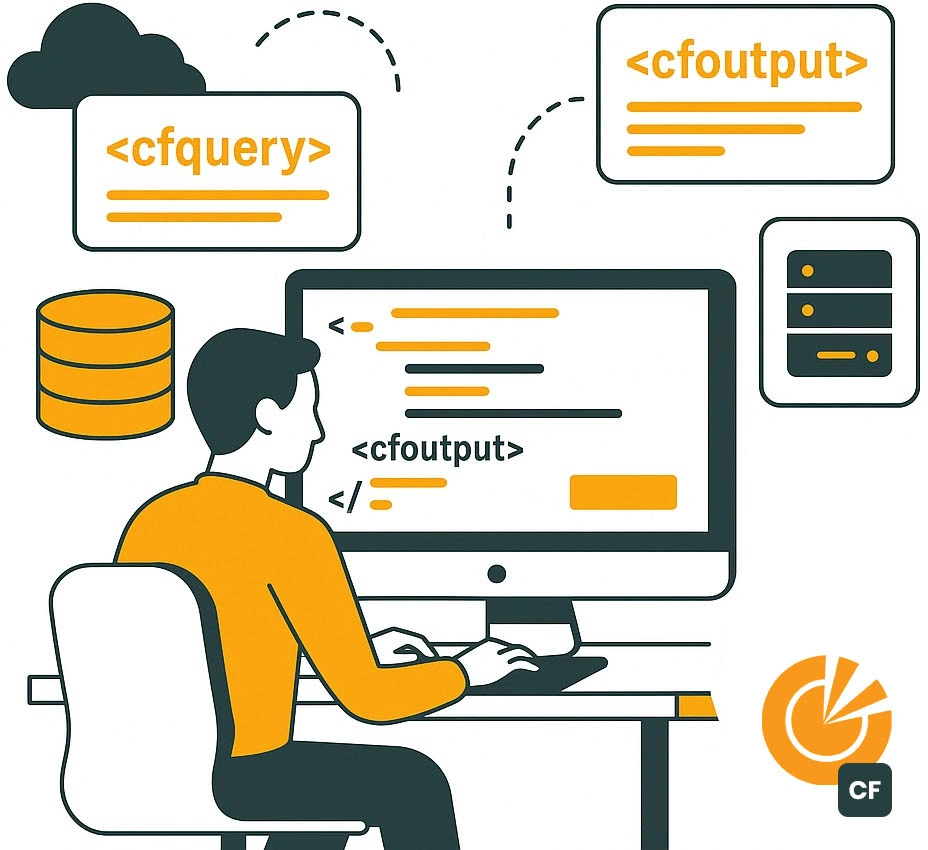
Almost no business application lives alone anymore. Your ColdFusion system needs to talk to payment processors, shipping carriers, accounting platforms, CRMs, identity providers, inventory systems, and whatever internal service the operations team stood up last year. CFML handles this well, and it has for a very long time, but the difference between an integration that runs quietly for years and one that fails silently at 2 a.m. is entirely in how it was built. We write integrations with real error handling, retry logic, timeout control, credential rotation, and logging that tells you what actually happened rather than that something went wrong. We map the data properly on both ends instead of forcing a fragile translation layer that nobody wants to touch later. If the systems you are connecting sit outside the ColdFusion world entirely, that work overlaps with our broader API integration practice, and the same engineering standards apply. Connecting an existing CFML system to a modern AI provider is handled separately under our ColdFusion AI integration services.
A ColdFusion application that has been running for fifteen years is not a liability. It is a business asset that has already absorbed thousands of hours of institutional knowledge, edge cases, and hard-won corrections that no rewrite will reproduce cheaply. The honest problem is usually not the platform. It is accumulated shortcuts, undocumented behavior, dead code nobody dares delete, and a structure that made sense for a smaller version of the business. Modernization means improving and extending what already runs. We refactor the code that actually causes pain, replace deprecated tags and functions, tighten the data layer, introduce source control and repeatable deployment if those are missing, and bring the interface forward so it does not look like the year it was written. The application keeps its behavior and its history. It simply stops being fragile. That approach is a core part of our ColdFusion development services, and it consistently costs a fraction of starting over.
Running an unsupported ColdFusion version is the single most common risk we find, and it is rarely a decision anybody made on purpose. The upgrade was postponed once, then again, and eventually the version fell off the support roadmap while the application kept working well enough that nobody escalated it. The exposure is real: no security patches, no vendor support path, growing incompatibility with current Java, and mounting difficulty finding anyone willing to touch it. Remediation is methodical work, not a gamble. We inventory what the application actually uses, identify every tag, function, and library affected by the target version, stand up a parallel environment, and work through the breakage list before anything touches production. Database drivers, scheduled tasks, custom tags, and third-party jars all get verified. You get a tested upgrade path with a rollback plan, rather than a weekend outage and a hope. Upgrade remediation is one of the most requested pieces of our ColdFusion development services, and it is the work that most often pays for itself immediately. Questions about whether the platform justifies that investment are covered on our is ColdFusion still used 2026 page.
ColdFusion 2026 is the current release and the version we target for upgrade work. That matters for planning, because the gap between where an application sits today and where it should land determines the effort, the testing scope, and the sequence. An application on a recent version is a straightforward move. One that has been sitting still for several release cycles needs staged work, and we scope it that way rather than promising a single jump. We also plan around what the current platform makes possible instead of what was possible when the application was written, because features that once required third-party libraries or custom Java are now handled natively. Our ColdFusion development services include mapping that path in writing before any code changes, so the business knows the cost, the timeline, and what improves at each step. If you also run non-CFML systems, our custom software development team handles those on the same schedule.
The most expensive risk in CFML work is concentration. One developer knows the application, holds the deployment steps in his head, and is the only person who understands why a particular module behaves the way it does. When that person retires, changes jobs, gets sick, or simply raises his rate, the business discovers exactly how exposed it was. Hiring a team removes that failure mode. More than one engineer knows your codebase. Work continues during vacations and illness. Reviews happen before code ships instead of after something breaks. Documentation exists because more than one person needs it. Institutional knowledge lives in the firm rather than in one head. That continuity is the practical reason businesses move from an individual contractor to ColdFusion development services delivered by an organization, and it is usually the first thing owners tell us they wish they had done sooner.
We use AI inside our own delivery work, and we are direct about what that means. It is not a feature we are selling you and it is not a bot writing your application unsupervised. It means faster comprehension of unfamiliar legacy code, stronger and more consistent code review, broader test coverage generated in less time, and safer upgrade work because more of the surface gets checked before deployment. On modernization projects it is genuinely transformative: a system nobody has documented in a decade can be mapped in days rather than months. Every output is reviewed by an engineer who is accountable for it. The result you see is shorter timelines and fewer regressions, not experimental code. If you want AI capability built into your application itself, that is a different service, covered by our ColdFusion AI integration services. Owners weighing that investment against platform longevity usually read our is ColdFusion still used 2026 overview first.
When the application and the server belong to different vendors, every incident starts with an argument. The host says the code is at fault, the developer says the server is at fault, and the business sits down for an hour while two companies negotiate whose problem it is. We remove that entirely by hosting the ColdFusion applications we maintain on top-tier infrastructure, with one point of contact for both. Proactive monitoring watches the application and the server together, and by the time you notice something is wrong we have usually already been alerted and started fixing it. Patching, JVM tuning, connection pool sizing, scheduled task health, certificate renewal, and backup verification are handled as ongoing work rather than as emergencies. Hosting is bundled into our ColdFusion development services rather than sold as a separate contract, so accountability never splits between two vendors. Hardening those environments draws on the same discipline as our managed security services practice.
Nearly every ColdFusion performance complaint we investigate turns out to be a database problem wearing an application costume. Missing indexes, queries built inside loops, no caching where caching is obvious, result sets pulling thousands of rows to display twenty, and schema decisions that made sense before the table grew past a million records. We treat the data layer as part of the application rather than as someone else's territory, which is why our ColdFusion development services include query profiling, index review, and schema work alongside code changes. Deeper structural work runs through our database development practice, and when the front end needs rebuilding as a genuine logged-in system rather than a set of pages, our web application development team handles that alongside the CFML work.
Generating invoices, statements, contracts, and reports as PDFs has been a CFML strength for as long as the platform has existed, and it is still one of the fastest ways to remove manual effort from a business process. We build that work into the applications we maintain, including automated generation, templating, archiving, and delivery. Where extraction and classification of incoming documents is the goal, our ColdFusion PDF automation with AI page covers that specialty in depth. Routine document generation inside an existing system is simply part of our ColdFusion development services.
If you are weighing whether to keep investing in a CFML system, the useful first step is a conversation with people who work in the platform every day rather than a sales pitch from someone who wants to replace it. We will look at what you are running, what version you are on, what is actually causing pain, and what it would take to fix it. Sometimes the answer is a two-week upgrade. Sometimes it is a staged modernization over several months. Occasionally the honest answer is that a particular module should be rebuilt while the rest stays exactly where it is. You will get that assessment in plain language with real numbers attached. Reach out to CTO to talk through your application, your version, and your roadmap, and put a team behind the system your business depends on. Our ColdFusion development services start with that conversation, and there is no cost to having it. A short discussion about your platform, your risk, and your timeline is usually enough to make the right decision obvious, and it commits you to nothing beyond an honest look at where the application stands today. Whatever we recommend, you will understand why, and you will leave the call knowing what the realistic options actually cost. That clarity is worth having even if you decide to keep everything exactly as it is.
Yes, and it is a large share of what we do. We start by reading the codebase, documenting how it actually works, and identifying the risks that are not obvious from the outside. You get that assessment before any changes are made, so the handover is orderly rather than a leap of faith.
No. We work on applications running older versions every day, and we will not hold your feature requests hostage to an upgrade. We will tell you plainly what risk the current version carries and what remediation would involve, then let you decide the order.
Rarely. The value of a team is coverage and continuity, not headcount billed to your project. Smaller applications typically use a few hours a month for maintenance and monitoring, with more capacity available when a project comes up, which is why ColdFusion development services scale down as well as up.
Free Consultation
Please fill in the fields below. All fields are required.
CTO (Cipoletti Technology Organization) / sales@cipoletti.ai / 888-CTO-0206 / 1636 N. Cedar Crest Blvd / Allentown PA 18104