CTO: ColdFusion AI Integration Services
You have a ColdFusion application that runs the business and has for years. It handles the workflows, holds the data, and does its job reliably every day. The one thing it cannot do is the thing everyone is suddenly asking for: intelligent features powered by modern AI. The good news is that you do not need to rebuild anything to get them. CTO (Cipoletti Technology Organization) provides ColdFusion AI integration services that add large language model capability directly to the CFML code you already run, turning a stable legacy system into one that can read, write, summarize, classify, and hold a conversation like the newest software on the market.
Free Consultation
Please fill in the fields below. All fields are required.
CTO / sales@cipoletti.ai / 888-CTO-0206 / 1636 N. Cedar Crest Blvd / Allentown PA 18104
<CTO> | <Cybersecurity> | <AI> | <Websites> | <IT> | <Coldfusion> | <Programming>
ColdFusion: <Usage 2026> | <PDF Automation>
ColdFusion AI integration services for legacy applications
This page is written for one specific situation: an existing, working application built on ColdFusion that needs to gain AI features without a rewrite. That is a different problem from building a new AI product from scratch, and it calls for a different approach. The goal is enhancement, not replacement. The years of business logic already encoded in your application stay exactly where they are, untouched and fully working, while a focused layer of AI capability is added on top of them. Done well, the integration feels native to the application, as though the intelligence had been part of it all along.
CTO has built CFML systems for a long time and works with the modern AI providers every day, which is the combination this work requires. Adding AI to a legacy platform is not about chasing a trend; it is about giving a proven system new abilities that the business genuinely needs. The ColdFusion AI integration services described here are practical and concrete, aimed at real features you can put in front of staff and customers, not at abstract experiments. Everything below assumes you want to keep the application you have and make it smarter.
Adding intelligence to systems that already work
The typical candidate for this work is an application that has been in production for years and does everything it was designed to do. The problem is not that it is broken; the problem is that expectations have moved. Customers now expect a chat assistant. Staff now expect the system to draft text, summarize long records, and sort incoming information automatically. A few years ago none of that was possible inside a CFML application without enormous effort. Today it is straightforward, because the heavy lifting happens in external AI services that ColdFusion can call directly. CTO designs ColdFusion AI integration services around that reality, adding capability to the application rather than starting over with a blank slate.
Framing this as work for legacy applications is deliberate. The whole value proposition is that you keep what you already have. The database stays. The business rules stay. The integrations stay. The interface your users know stays. What changes is that specific points in the application gain intelligence: a field that now autocompletes intelligently, a screen that now summarizes a case file, a form that now classifies and routes a submission on its own. Each of those is a small, contained addition to a system that otherwise continues exactly as before, which is what makes the approach so low-risk compared to a rebuild. That low risk is also why owners who once questioned whether is ColdFusion still used 2026 grow comfortable investing in the platform again rather than fleeing it.
What integrating AI into CFML actually involves
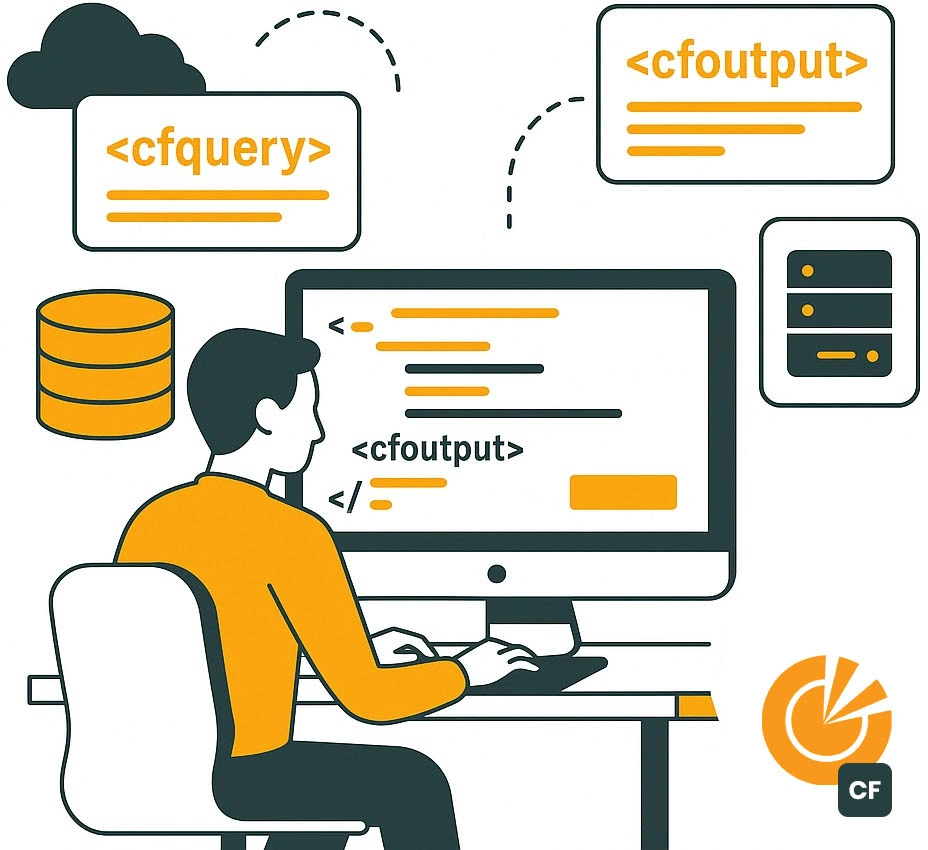
At a technical level, adding AI to ColdFusion is more approachable than many owners expect. Modern AI capability is delivered through external services that accept a request and return a result, and ColdFusion has always been good at talking to external services. The application sends information to the AI provider, the provider does the intelligent work, and the application receives the result and uses it like any other piece of data. There is no exotic infrastructure to stand up and no need to retrain anyone on a new language. The CFML developers who maintain your system can work with these integrations using skills they already have, guided by a partner that has done it before.
How ColdFusion calls AI over HTTP and REST
The mechanism is the same one that powers most modern integrations. ColdFusion makes an HTTP request to the AI provider's REST endpoint, sending a prompt and any relevant context along with it. The provider processes the request and returns a structured response, typically as JSON. ColdFusion parses that response and the application does whatever the feature requires with it, whether that means displaying generated text, storing a classification, or acting on an extracted value. Because this is ordinary request-and-response work, it slots naturally into existing CFML code. CTO builds these calls with proper error handling, sensible timeouts, and safe handling of the data being sent, so the ColdFusion AI integration services hold up under real production load rather than only working in a demo.
The same pattern supports more advanced techniques when a feature needs them. Retrieval of relevant records before a prompt is sent, embeddings for semantic search across your own content, and multi-step prompting can all be implemented within the application. None of this requires abandoning ColdFusion; it requires applying these patterns thoughtfully within it. The right approach depends on the feature, and part of the engagement is choosing the simplest method that delivers the result the business is after.
Practical AI features you can add
The features that matter most are the ones that solve a real problem, and a handful of them cover the majority of requests. Chat assistants let users ask questions in plain language and get answers drawn from your application's data or documentation. Summarization condenses long records, case notes, threads, or reports into a few clear sentences, saving staff the time of reading everything in full. Classification automatically sorts incoming items by type, priority, department, or any category that matters, removing a tedious manual step. Generation drafts text such as replies, descriptions, summaries, or first-pass content that a person can then review and finalize. Each of these is a standard outcome of ColdFusion AI integration services, and each one tends to pay for itself quickly in saved time. Document generation and extraction follow the same request-and-response model but are substantial enough to warrant a dedicated approach, detailed under ColdFusion PDF automation with AI.
What makes these features powerful inside a legacy application is that they operate on the data the application already holds. A summarization feature does not work on generic text; it works on your records. A classification feature does not sort hypothetical items; it sorts the real submissions flowing through your system. A chat assistant does not answer in a vacuum; it answers using your content. That grounding in the application's own data is exactly why integrating AI into the existing system beats bolting on a disconnected external tool. The intelligence lives where the work already happens.
Built on OpenAI and Anthropic
The intelligence in these integrations comes from the leading AI providers, and CTO works with the ones that have proven themselves in production. OpenAI's models and Anthropic's Claude models are the providers actually integrated into client applications, chosen for their reliability, their strong handling of business text, and their suitability for the kinds of features described above. The application calls whichever provider fits the task, and the integration can be designed so that a provider can be changed later without rewriting the feature. This is the practical, vendor-aware side of ColdFusion AI integration services: using established AI platforms rather than experimental ones, and structuring the work so the business is not locked into a single dependency.
Choosing between providers, and between models within a provider, is part of the design. Some tasks call for the strongest reasoning available; others run perfectly well on faster, lighter models that cost less per request. Getting that balance right keeps the feature responsive and the running costs sensible. CTO makes those choices based on what each feature actually needs, so the integration performs well without spending on capability the task does not require.
Enhancement without a rewrite
The single most important promise of this work is that it does not require replacing your application. A rewrite throws away years of refined logic, introduces months of risk, and costs far more than the problem warrants when the goal is simply to add a few intelligent features. Integration takes the opposite path. The existing system keeps running throughout, the new capability is added in contained pieces, and each piece can be tested and deployed on its own. If you only want a chat assistant today, that is all that gets built; other features can follow later. CTO structures ColdFusion AI integration services as additions to a healthy system rather than as a reason to start over, which is the whole point of choosing integration over reconstruction.
This incremental approach also lets the business see value early. Rather than waiting through a long rebuild before anything ships, you get one working feature, then another, each delivering benefit as it lands. That steady, low-risk progress is far easier to justify than a single large project with an uncertain payoff at the end. It also keeps control in the owner's hands, since each addition is a separate decision rather than a commitment to an all-or-nothing transformation.
Part of keeping a ColdFusion application current
Adding AI is one piece of a larger picture: keeping a long-running application healthy, supported, and competitive rather than replacing it. Owners who have already settled the broader question of whether is ColdFusion still used 2026 usually arrive at this work next, because once it is clear the platform is here to stay, the natural follow-up is what new capability it can gain. ColdFusion AI integration services answer that question directly. They take a system that has proven itself over years and give it the intelligent features that keep it modern, all without the cost and disruption of moving to a different stack. The platform is actively developed, with native AI capability of its own, which makes it a sensible foundation to keep building on rather than a dead end to escape.
Intelligent text and chat features are only one branch of what AI can add to a CFML system. Document-heavy operations are another, and they deserve their own focused treatment. Businesses that generate, process, and extract data from PDFs and other documents at volume can automate that work on the same platform, a subject CTO covers separately under ColdFusion PDF automation with AI. Keeping that work on its own page reflects how the engagements actually differ: text and chat integration solves one set of problems, while document automation solves another, even though both run on ColdFusion and both draw on the same AI providers. Many organizations eventually want both, and the ColdFusion AI integration services described here can sequence those additions to match the priorities of the business.
The thread connecting all of it is preservation. Each addition, whether conversational AI, automated classification, or document processing, is built onto the existing application rather than carved out of a replacement for it. The investment goes into new capability, while the proven logic, the data, and the familiar interface remain firmly in place. That is what makes modernizing a stable system through targeted AI work so much more sensible than rebuilding it: the business gains the future without surrendering everything it already relies on, and it does so on a timeline and budget that a full rewrite could never realistically match. ColdFusion AI integration services exist precisely to make that path practical for the applications businesses cannot afford to disrupt.
Connecting data, APIs, and access controls
AI features rarely stand alone; they connect to the data and systems the application already uses. The database is usually the most important integration target, since the intelligent features draw on the records stored there and often write results back to them. CTO's broader engineering work, including database development Allentown and custom software development Allentown, means the data layer is handled with the same care as the AI layer. When a feature needs to reach beyond the application, API integration Allentown connects it to the other systems involved, so the AI has the context it needs and the results land where they belong.
Security and access control are treated as part of the integration, not an afterthought. Data sent to an AI provider must be handled responsibly, sensitive information must be protected, and the feature must respect the permissions already enforced in the application. A user should never see AI output drawn from records they are not allowed to access. CTO builds these safeguards into the work so the intelligence respects the same boundaries the rest of the system does. For organizations weighing where AI fits across their wider technology, AI consulting Allentown and web application development Allentown round out the picture, and AI automation Allentown extends the same ideas into broader workflows.
How an integration project comes together
A successful engagement starts by identifying the one feature that delivers the most value, not by trying to add everything at once. CTO reviews the application, understands the data and the workflows, and pins down exactly what the chosen feature should do. From there the integration is designed, built against the AI provider, tested with real data, and deployed into the running system. Because the work is contained, it can move quickly and without disrupting daily operations. Once the first feature proves itself, the same process repeats for the next, building intelligent capability into the application one solid step at a time rather than in one risky leap.
Throughout the project, the emphasis stays on production quality. A demo that works once is easy; a feature that holds up under real users, real data, and real edge cases is the actual deliverable. That is why CTO builds in error handling, monitors how the integration behaves, and tunes it based on how it performs in practice. The result is AI capability you can rely on, embedded in the system your business already trusts, rather than a fragile experiment that breaks the first time someone uses it in an unexpected way.
Add AI to the ColdFusion application you already run
If you have a working ColdFusion system and you want it to do the intelligent things modern software now does, you do not have to choose between staying on a stable platform and gaining AI capability. You can have both. CTO delivers ColdFusion AI integration services that add chat, summarization, classification, generation, and more to the application you already depend on, built on OpenAI and Anthropic, connected to your data, and deployed without a rewrite. The starting point is a single high-value feature and a conversation about what it should do. Reach out to CTO to talk through your application and the AI capability you want to add, and take the first practical step toward a smarter system that keeps everything you have already built and the proven stability your business depends on every day.
Free Consultation
Please fill in the fields below. All fields are required.
CTO / sales@cipoletti.ai / 888-CTO-0206 / 1636 N. Cedar Crest Blvd / Allentown PA 18104